Laguna de Horcones · Confluencia · Plaza Francia · the summit
Hiking Aconcagua
The lagoon walk, the Confluencia day hike, the base camp treks and the summit expedition,
told apart honestly, with the permits, the seasons and the tours from Mendoza worth booking.
Facts checkedPark rules, permits and heights from the park and Argentina's official sources
Real guest ratingsLive GetYourGuide figures, low review counts included
Refund terms per tourEvery tour here refunds in full up to 24 hours ahead
Secure checkoutBook on GetYourGuide, instant confirmation
Tours and hikes
Choose your Aconcagua tour
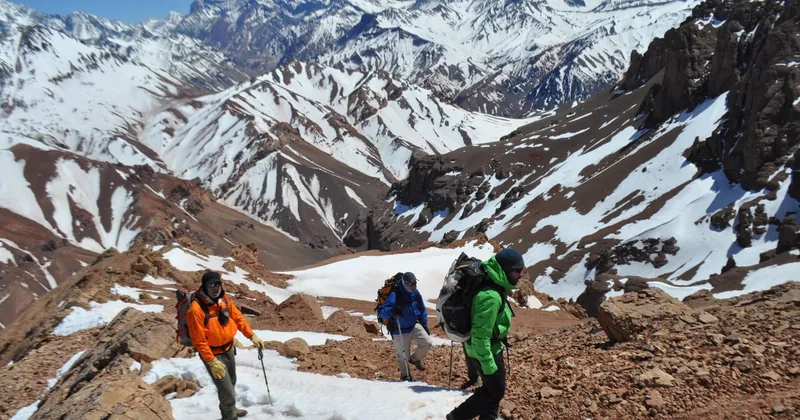
In the centre, the one day tour that actually hikes into the park, up to Confluencia camp. On
the left, the most-booked high mountain day from Mendoza, with the Aconcagua viewpoint. On the right, the guided
summit expedition.
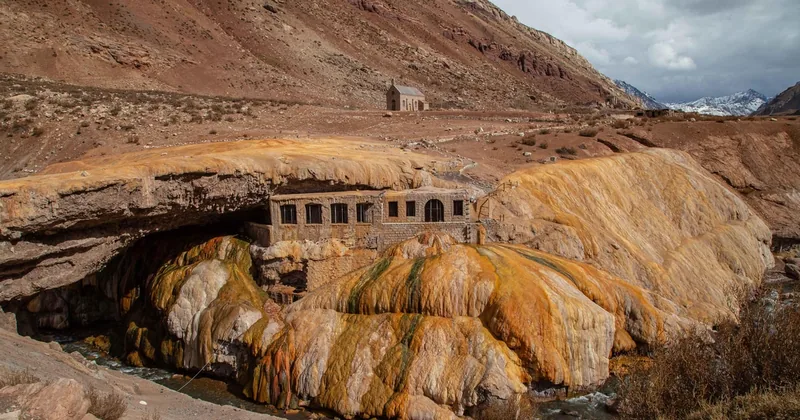
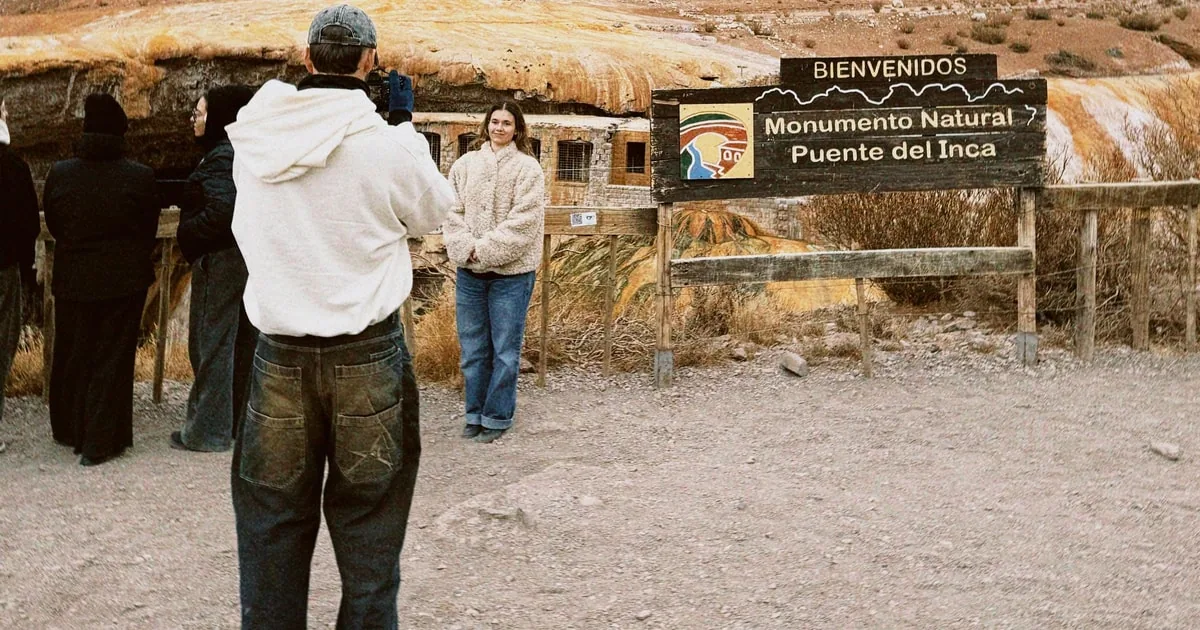
The classic high mountain day from Mendoza: Potrerillos, Uspallata, Puente del Inca and the Aconcagua viewpoint. A scenic drive with short walks, not a hike.
What's included
Hotel pickup and drop-off in Mendoza
A guide on board all day
Stops at Potrerillos, Uspallata and Puente del Inca
The day tour that walks into the park: 3 to 4 hours up the Horcones valley to Confluencia, the first camp on the summit route. Private, with a mountain guide.
What's included
Private return transport from Mendoza with a driver
A professional mountain guide with Aconcagua experience
A guided summit expedition on the Normal Route via Plaza de Mulas. A fast 12-day plan: most teams take 18 to 20, so arrive fit and already acclimatised.
What's included
Mountain guides and their expenses
Meals, tents, mules and cooking gear
Transport from Mendoza and back
Climbing gear, insurance and porters not included
Ask the operator whether the park permit is included
The first row is the baseline: drive to the park entrance at Horcones and walk the short lagoon
loop yourself, with a day ticket from the park. Each tour below adds something: transport from Mendoza, a guide,
the Confluencia hike, a quieter trail or the whole expedition to the summit.
Option
Starts
Best for
Length
Rating
Cancel
On your own, Laguna de Horcones loop
Horcones park entrance, by car
An easy close look at the South Face, with a park day ticket
The park charges its own ticket for the Laguna de Horcones loop and a permit for the
Confluencia hike, and most tours list them as not included: check each listing. The Cristo Redentor road opens
only in summer.
What the tour pages don't tell you
Most Aconcagua tours don't hike.
The tours sold as "Aconcagua" from Mendoza are nearly all the high mountain day trip: a long,
beautiful drive up Route 7 with stops at Potrerillos, Uspallata and Puente del Inca, and half an hour or so at
the park viewpoint facing the South Face. It is a great day out, but you walk a few hundred metres, not a trail.
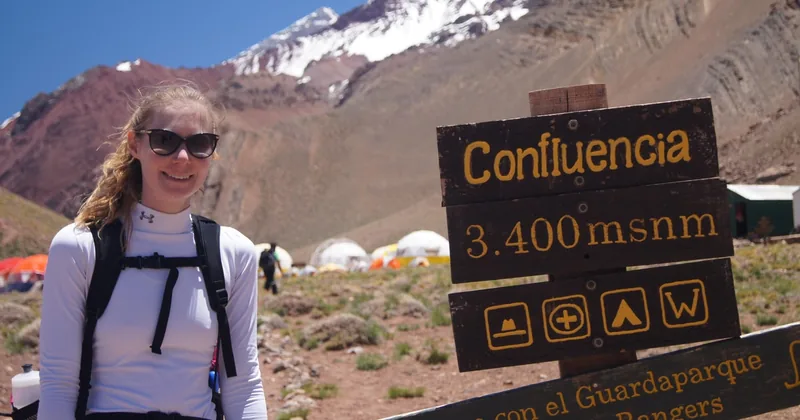
The real day hike goes 3 to 4 hours up the Horcones valley to Confluencia, the first camp on the
summit route, and it needs a day-trek permit from the park. Beyond that, treks reach the Plaza Francia viewpoint
and base camp, and only the summit is a climbing expedition: about three weeks, non-technical on the
Normal Route, and a serious test of altitude, cold and wind.
6,961 m
the height of Aconcagua (6,960.8 m by Argentina's
IGN in 2012), the highest mountain outside Asia and the top of the Americas.
HorconesConfluenciaPlaza FranciaSouth FaceRoute 7
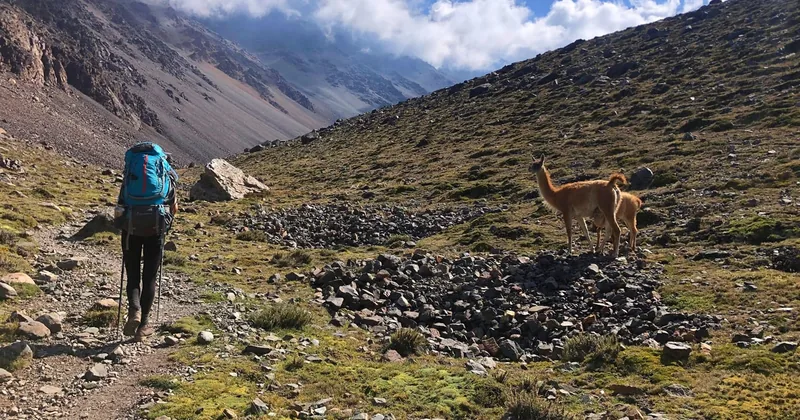
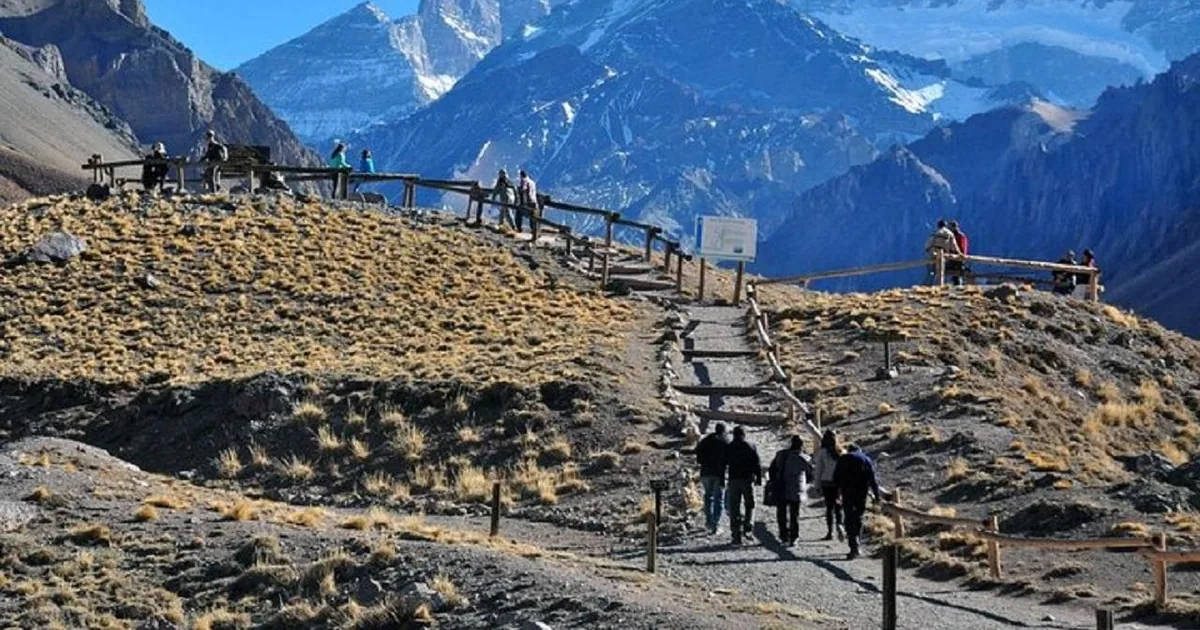
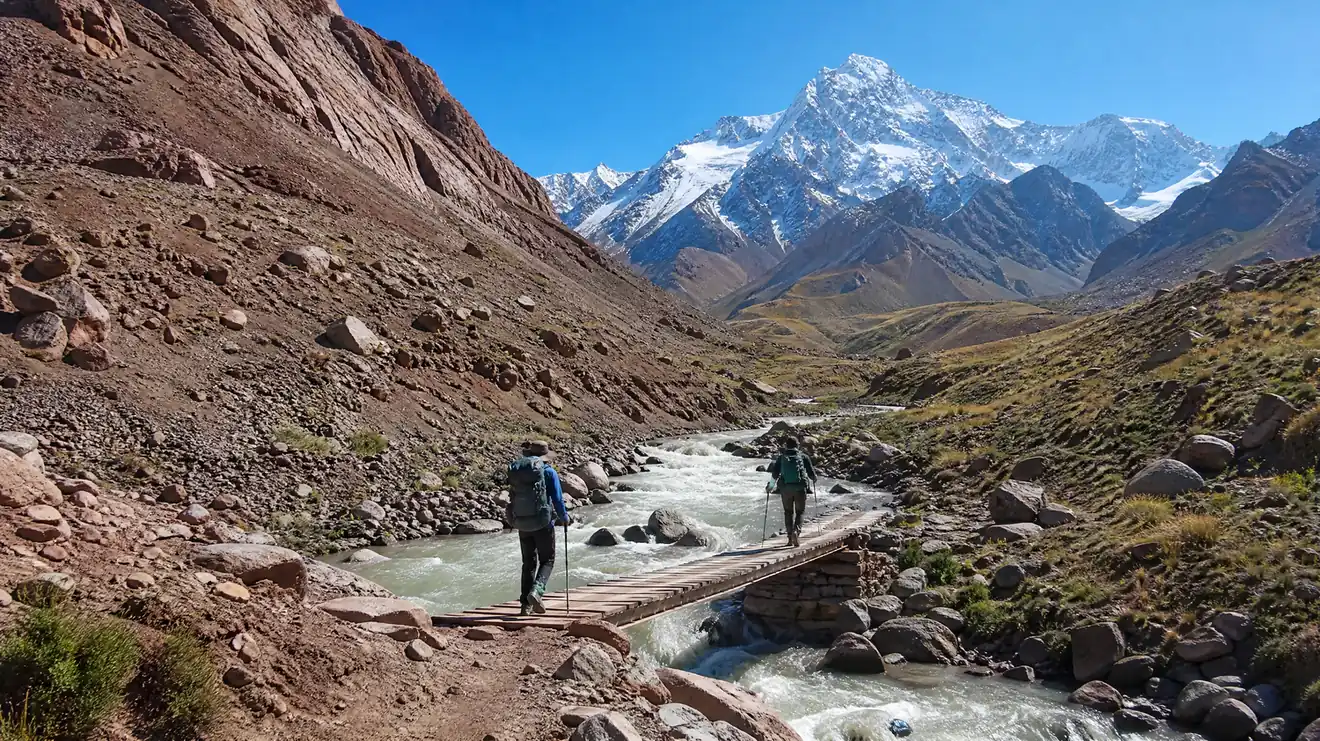
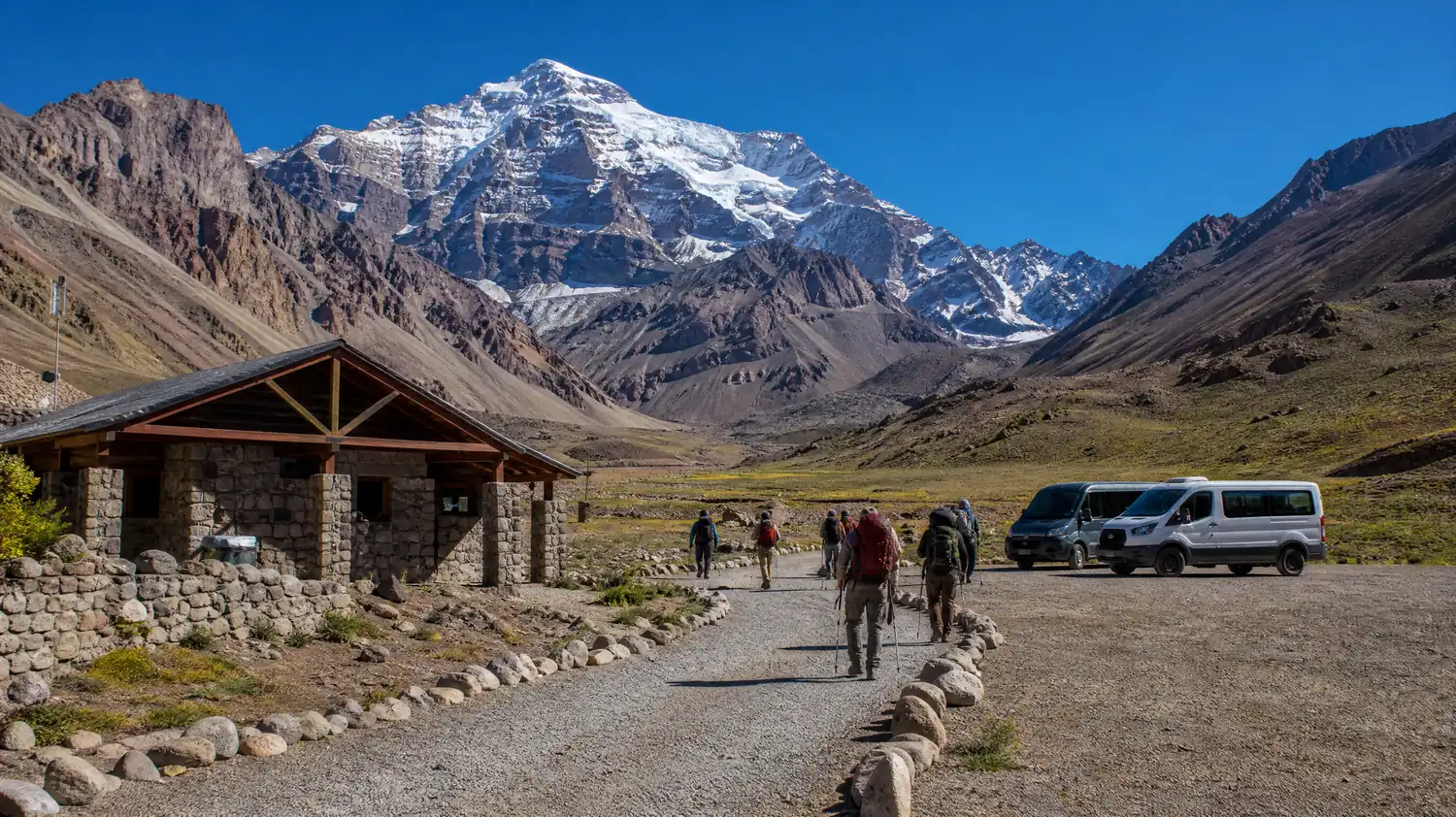
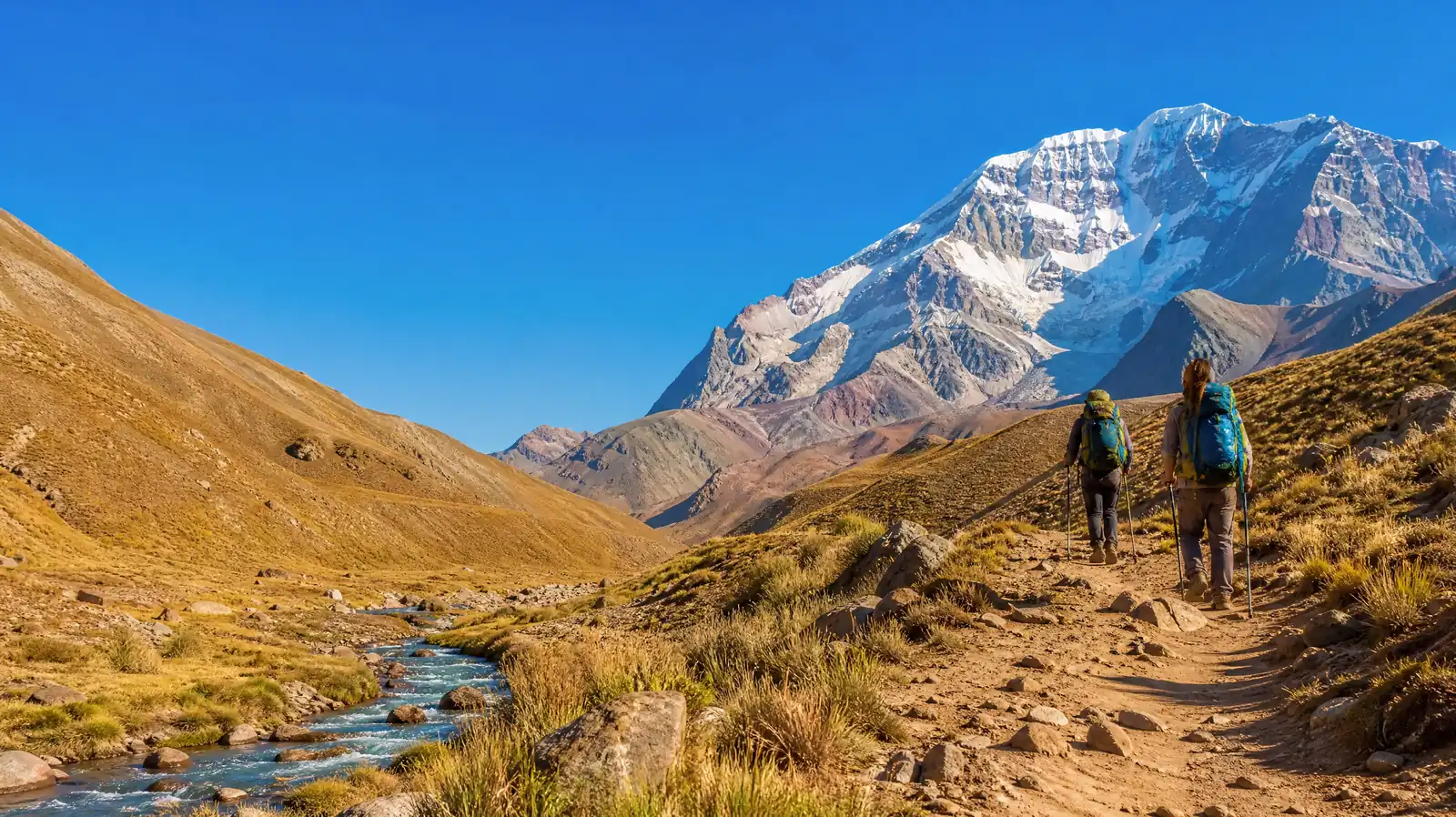
Up the Horcones valley, the way to Confluencia.
01
Need a guide?
Not for the lagoon or the day hike. For the 7-day base camp trek, a licensed outfitter.
02
How long?
1.5 hours for the lagoon loop, 6 to 8 hours for Confluencia, about three weeks for the summit.
03
When?
Hikes and climbs in the southern summer, roughly November to March; viewpoint tours all year.
04
Permit?
A day ticket for the lagoon, a day-trek permit for Confluencia, longer permits for treks and climbs.
The day hike
Horcones to Confluencia in four stages
The trail every trekker and Normal Route climber starts on. Be at the park entrance early: the
walk takes most of the day, and the drive from Mendoza about 3 hours each way.
01
Horcones entrance
The ranger post and visitor centre at about 2,900 m, just off Route 7. Show your permit and check in before you set off.
The start
02
Laguna de Horcones
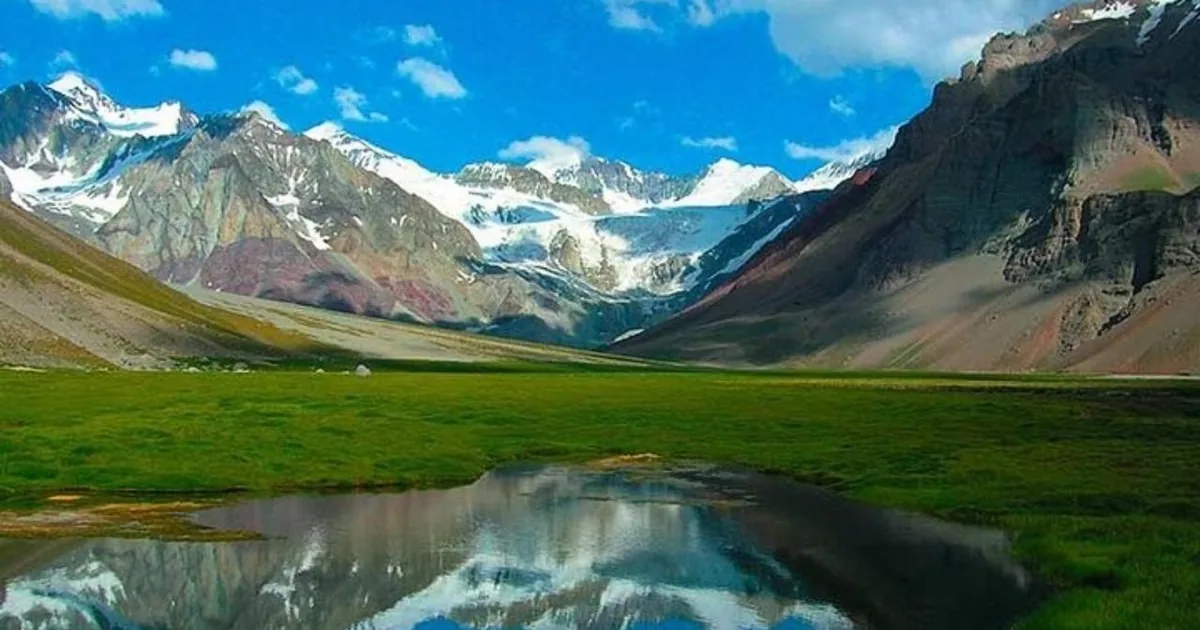
A small green lagoon with the South Face behind it. The short loop for day visitors ends here; the trek carries on up the valley.
The famous view
03
The Horcones river
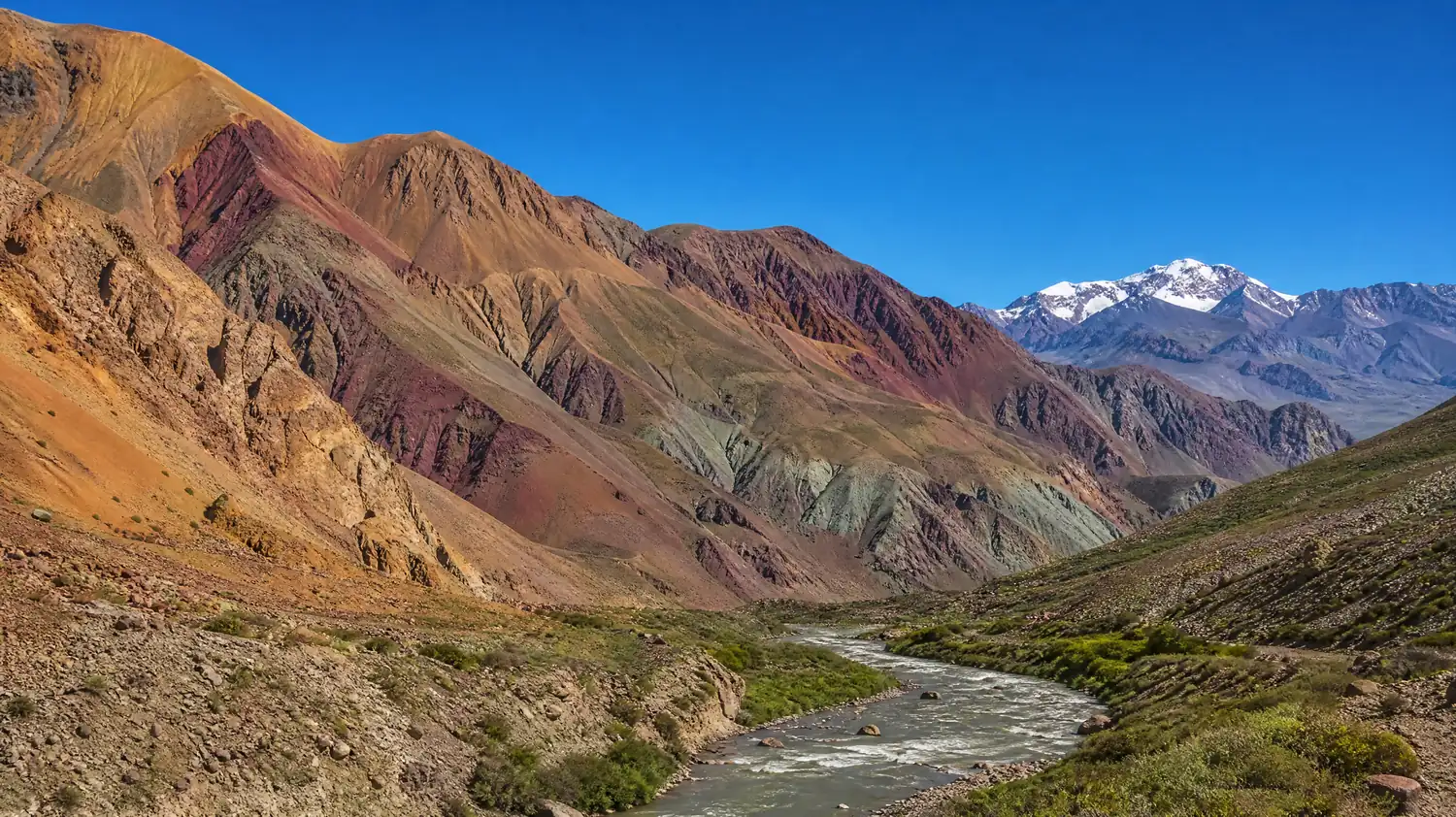
The path follows the river, crosses it on a footbridge and climbs steadily through dry, rust-coloured scree. Walk slowly and drink often.
The long, gentle pull
04
Confluencia
The first camp on the Normal Route, at about 3,400 m, where two valleys meet. Rest, eat and turn back the same way.
The ways to walk at Aconcagua, how to reach the park, what goes in your pack and the rules to know.
Laguna de Horcones loop: about 2 km and 1.5 hours from the entrance, easy, with a day ticket from the park.
Confluencia day hike: 6 to 8 hours return, about 500 m of climbing to roughly 3,400 m; day-trek permit.
3-day trek: two nights at Confluencia and a long day to the Plaza Francia viewpoint below the South Face.
7-day trek: up to Plaza de Mulas base camp at about 4,300 m, only with a licensed outfitter.
The summit: a climbing expedition of 18 to 20 days for most teams, with a 20-day park permit.
From Mendoza: about 180 km west on Route 7, roughly 3 hours by car.
Day tours: pick you up at your hotel in Mendoza and stop at the park viewpoint on the way.
By bus: local buses towards Las Cuevas stop at the park entrance, but most visitors come on a tour.
Stay closer: expedition teams often spend a night at Penitentes or Puente del Inca to acclimatise.
Mountain view: you cannot see Aconcagua from Mendoza city; it appears near the park.
Water: 2 to 3 litres for the day hike; the dry air and altitude dehydrate you fast.
Layers: a warm top, a windproof jacket, a hat and gloves, even on a hot day in Mendoza.
Sun: sunglasses, a sun hat and strong sun cream; the sun is fierce at altitude.
Feet: broken-in walking boots with good grip on loose scree.
Papers: your passport or ID and your permit or ticket, checked at the entrance.
Buying permits: online through the park's official system or through a licensed outfitter.
Insurance: climbers and 7-day trekkers need cover for mountain rescue and helicopter evacuation.
Medical checks: park doctors check overnight trekkers and climbers at Confluencia and Plaza de Mulas.
Altitude: walk slowly, drink plenty and turn back if a headache or nausea builds.
Rules change: check the current season on the park website before booking.
6,961 mThe summitHighest mountain outside Asia.
3,400 mConfluenciaThe day hike's goal.
4,300 mPlaza de MulasBase camp on the Normal Route.
3,832 mCristo RedentorOn the border, open in summer.
1897First ascentMatthias Zurbriggen, alone.
1983Provincial parkAconcagua Provincial Park created.
Where it starts
Horcones, the park entrance
Horcones ranger post and visitor centre
Route 7, Aconcagua Provincial Park, Las Heras, Mendoza
The Horcones entrance sits just off Route 7, a few kilometres past Puente del Inca and about 3 hours' drive
west of Mendoza. This is where the Laguna de Horcones loop begins, where day hikers and trekkers check in with
the rangers, and where the Normal Route to the summit starts. The high mountain day tours stop at the viewpoint
here; the Confluencia hike picks you up in Mendoza and drives you to the trail. The Polish Traverse route
starts further east, at Punta de Vacas.
Amazing day out with Christian, such a kind, patient and professional guide. The transport, coffee stop, guided hike, lunch offering and experience was so much more than I expected. Despite the long day it was a highlight of my time in Argentina!
★★★★★
Probably our favourite activity of Argentina so far! We were picked up at 7.30 am and did not return until 6.30 pm, and although the day was long we had plenty of breaks and stops along the way.
★★★★★
He took us off the beaten track to a quiet and unspoilt area and we didn't see anyone else all day. We did however see lots of wildlife including condors and guanacos.
★★★★★
The hike was great and Matias was very nice and shared a lot of nice facts about Aconcagua and the park. The commute was good and everything was on time. The lunch was more than we would expect from a high altitude hike!
★★★★★
The trek was stunning, rising to 3,600 metres with amazing views, but Vanina set the pace perfectly so it never felt too hard. She prepared a delicious lunch, guided us safely down and drove us back to Mendoza.
★★★★★
We had a fantastic day in the Aconcagua park with our driver and guide. He drove safely and skilfully and took us to see unique features at the Inca Bridge, which is a stunning place. We spent many hours in the car, and it was totally worth it.
★★★★★
I had the absolute pleasure of spending a day hiking to Confluencia in the breathtaking Aconcagua area with Pablo as my guide. He kept the hike perfectly paced and made the journey feel both rewarding and enjoyable.
★★★★★
We got good information in English, and when the mountain pass got closed in a snow storm, the tour operator thought on their feet and adapted the tour accordingly. The scenery on the tour is magnificent.
★★★★★
No pictures will ever capture this experience, the magical feeling and vastness of the Andes. Small group hiking in an untouched environment, with what felt like hiking with a friend.
Not hiking this time?
Ride the foothills instead
For a rest day after the mountain, or for anyone in your group who would rather not hike, the
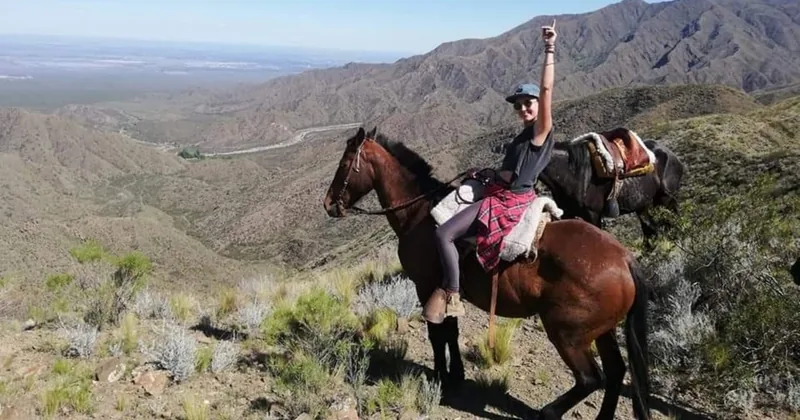
best-rated way into the Andes near Mendoza is on horseback, with a sunset over the foothills and a long dinner.
Sunset Horseback Ride & Asado
★ 4.9 · 697 reviews · GetYourGuide
For a rest day after the mountain, or for anyone in your group who would rather ride than hike: a family ranch in the foothills, calm horses for beginners, a sunset view from about 2,100 m and a big Argentine barbecue with wine. Full refund if you cancel up to 24 hours ahead.
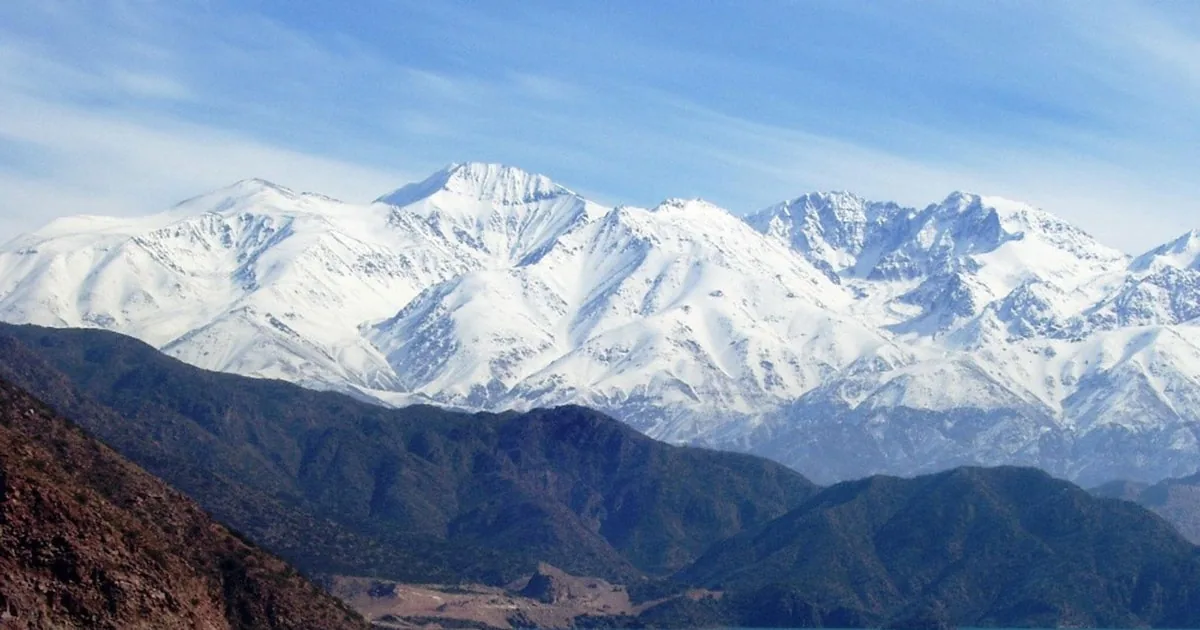
Aconcagua rises at the western edge of Mendoza province, about 15 km from the Chilean border, a
massif of rock and ice that tops out at about 6,961 m. It is the highest mountain outside Asia and South
America's entry in the Seven Summits, and it sits inside Aconcagua Provincial Park, created in 1983. Most people
who "hike Aconcagua" never go near the top, and that is the point of this guide: there are several very
different ways to walk here, and only one of them is a climb.
The lagoon and the viewpoint
The easiest way to stand in front of the mountain is the Laguna de Horcones loop, which starts at the park
entrance just off Route 7. It is about 2 km long and takes around 1.5 hours, past a small lagoon to a viewpoint
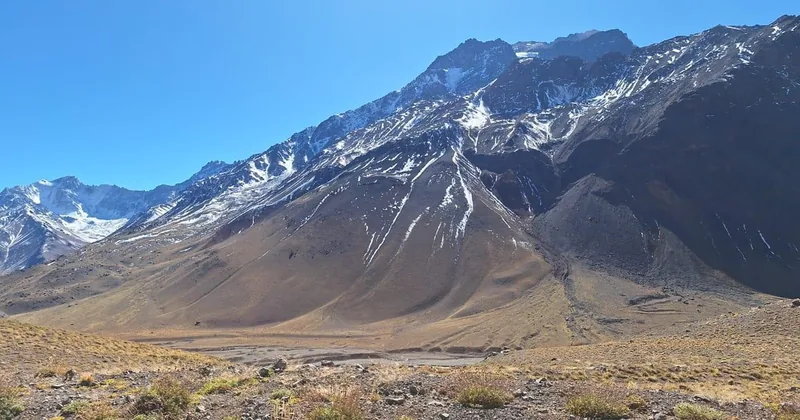
that faces the South Face, a wall of rock and ice about 3,000 m high. It is at roughly 2,900 m, so walk slowly
even though the path is easy. The park sells a day ticket for it, and most day tours from Mendoza stop at the
viewpoint here; some include the loop, many do not, so check before you book.
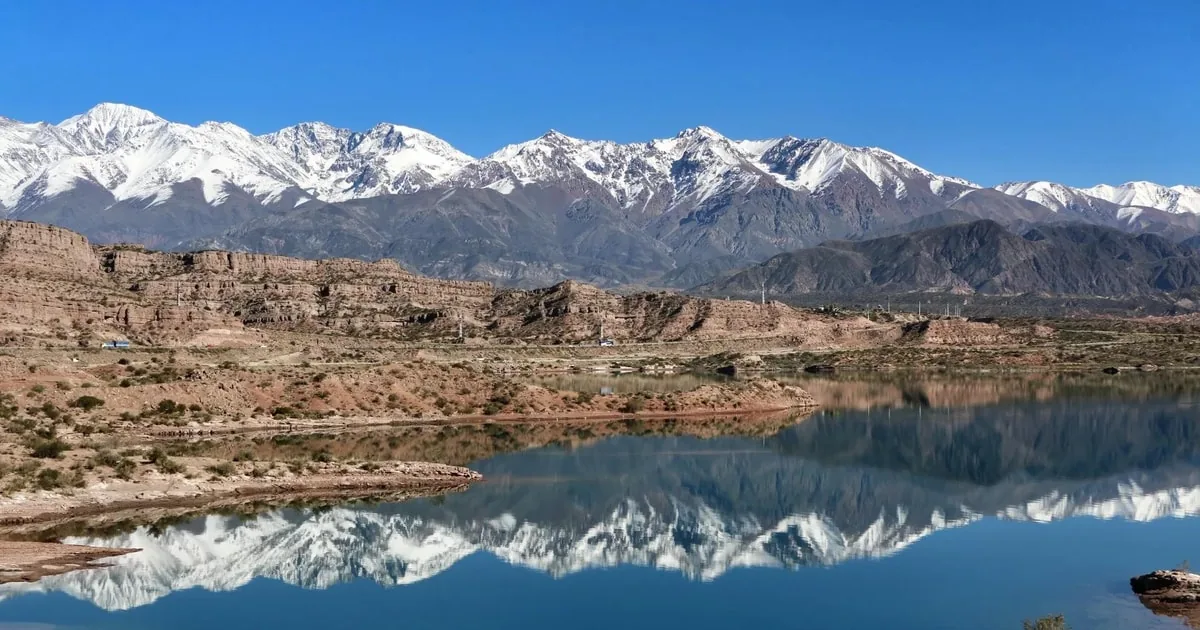
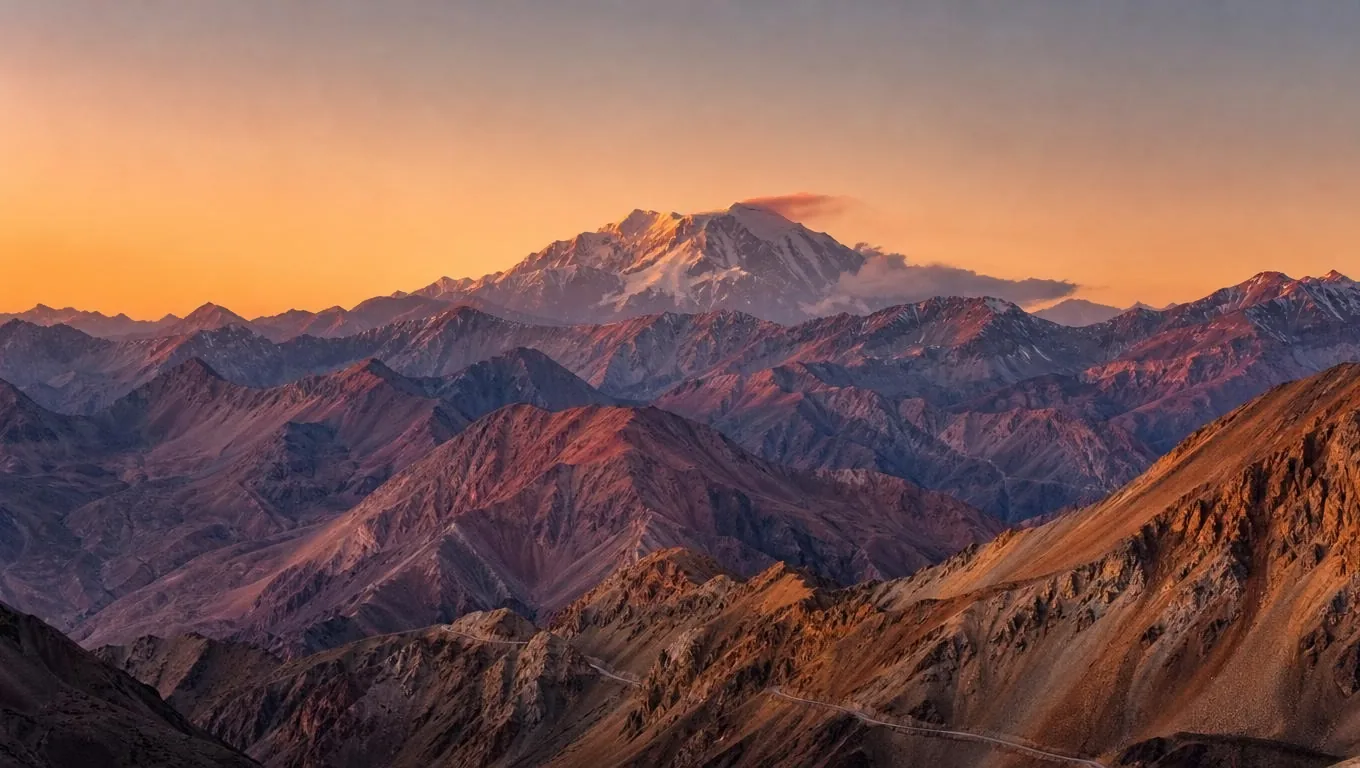
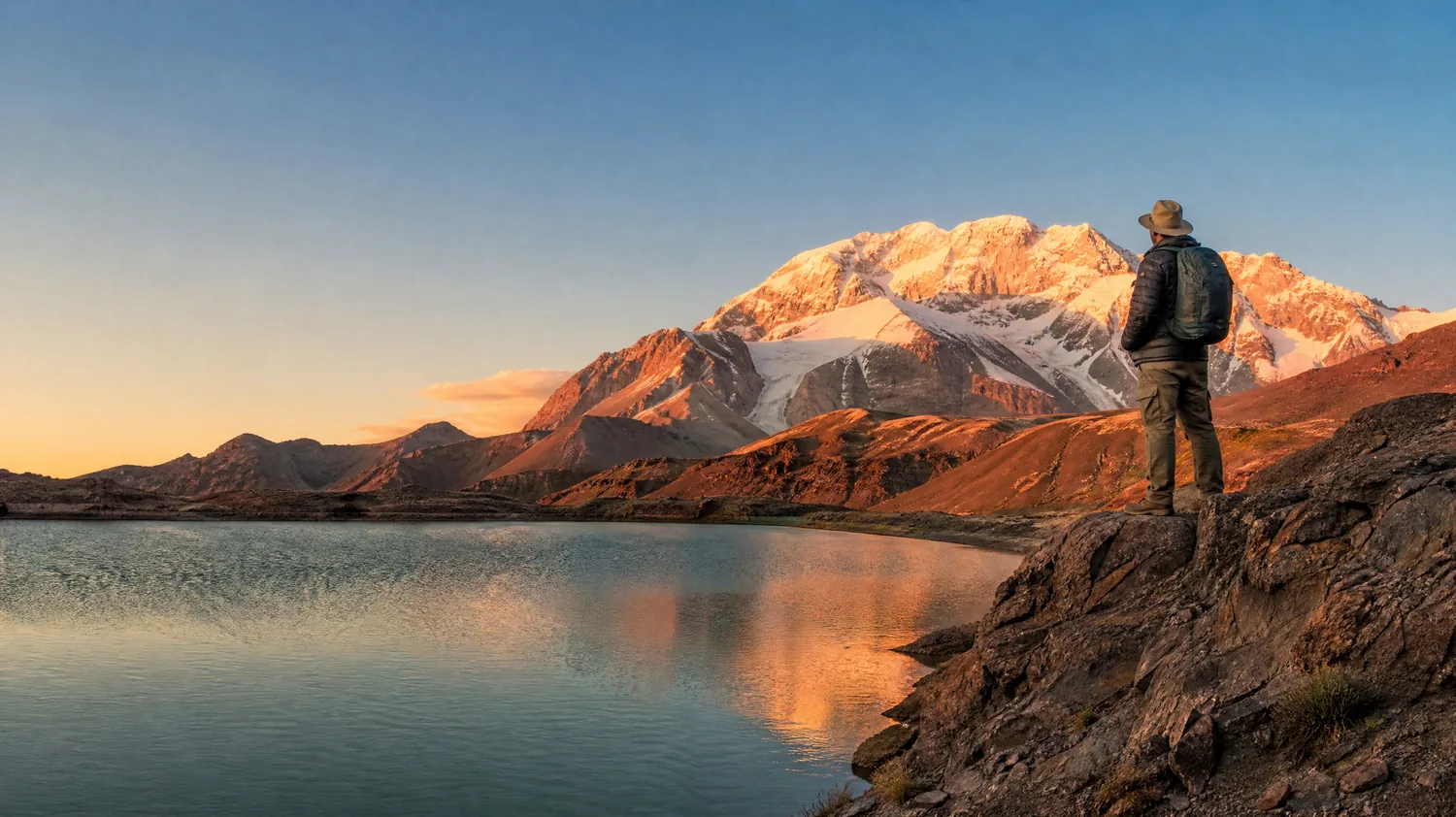
Golden hour by the water, with the massif turning pink.
Confluencia, the real day hike
From the same entrance, a trail follows the Horcones river north into the valley. After 3 to 4 hours of
steady walking and about 500 m of climbing you reach Confluencia, at about 3,400 m, the first camp on the
Normal Route, where expeditions spend their first nights. You need a day-trek permit booked in advance, you
must be at least 16, and the season runs roughly from mid-November to early April. It is not technical, but the
altitude makes it a real day's effort, and from Mendoza the whole outing takes about 12 hours.
The honest small print: a high mountain day tour shows you Aconcagua from the viewpoint;
it does not hike. If walking into the park is what you want, book the Confluencia hike, and budget for the park
permit, which tours list as not included. If you want the summit, you are looking at a climbing expedition of
about three weeks, not a longer hike.
The treks: Plaza Francia and base camp
With more time, a 3-day trek spends two nights at Confluencia and walks to the Plaza Francia viewpoint, at
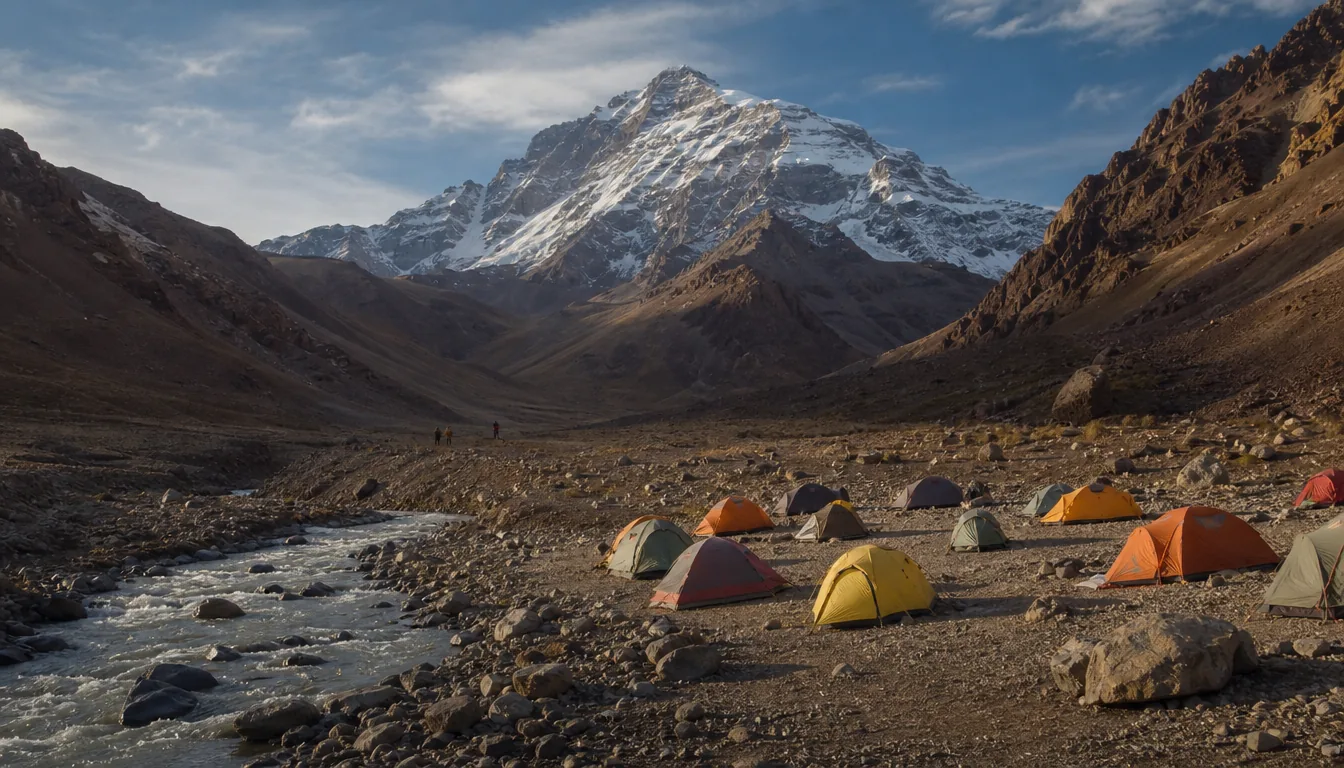
about 4,000 m, right below the South Face. The 7-day trek continues up the long Playa Ancha to Plaza de Mulas,
the Normal Route base camp at about 4,300 m, and must be done with a licensed outfitter. Trekkers may not go
higher than 4,300 m, and park doctors check everyone who stays overnight.
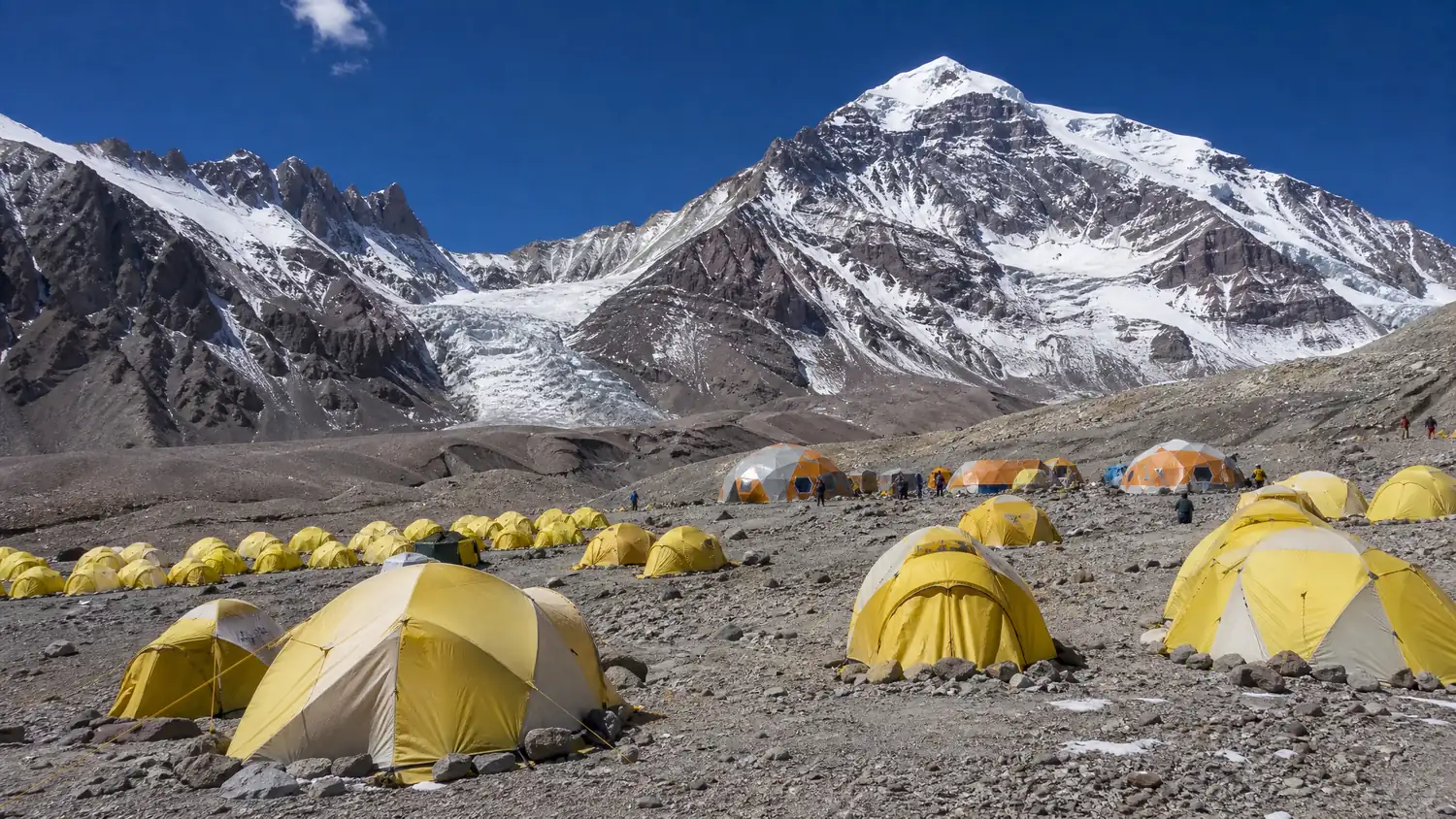
Plaza de Mulas, the Normal Route base camp at about 4,300 m.
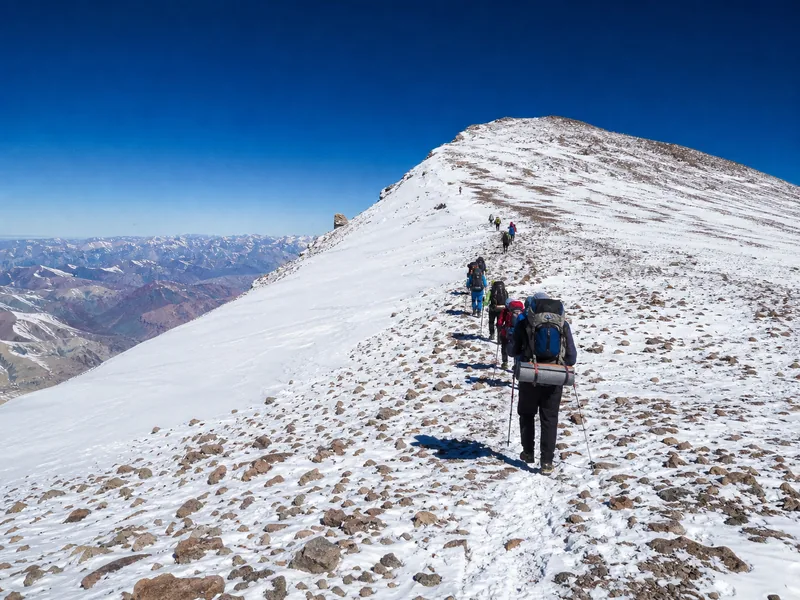
The summit is a climb
The Normal Route from Plaza de Mulas is non-technical: no ropes or ice climbing in normal conditions, though
you carry crampons and an ice axe. It is still one of the great high-altitude challenges. Teams move up through
camps at about 5,000, 5,500 and 6,000 m, then leave before dawn for a summit day of 10 hours or more, through
the wind of the Traverse and up the steep scree of the Canaleta. Only around a third of people who set out
reach the top. Most outfitters plan 18 to 20 days, and the time is what makes it safe with good preparation.
When to go
Hikes, treks and climbs happen in the southern summer, roughly November to March, with full park services
from about December to early March. January is the warmest and busiest month. The viewpoint tours run all year,
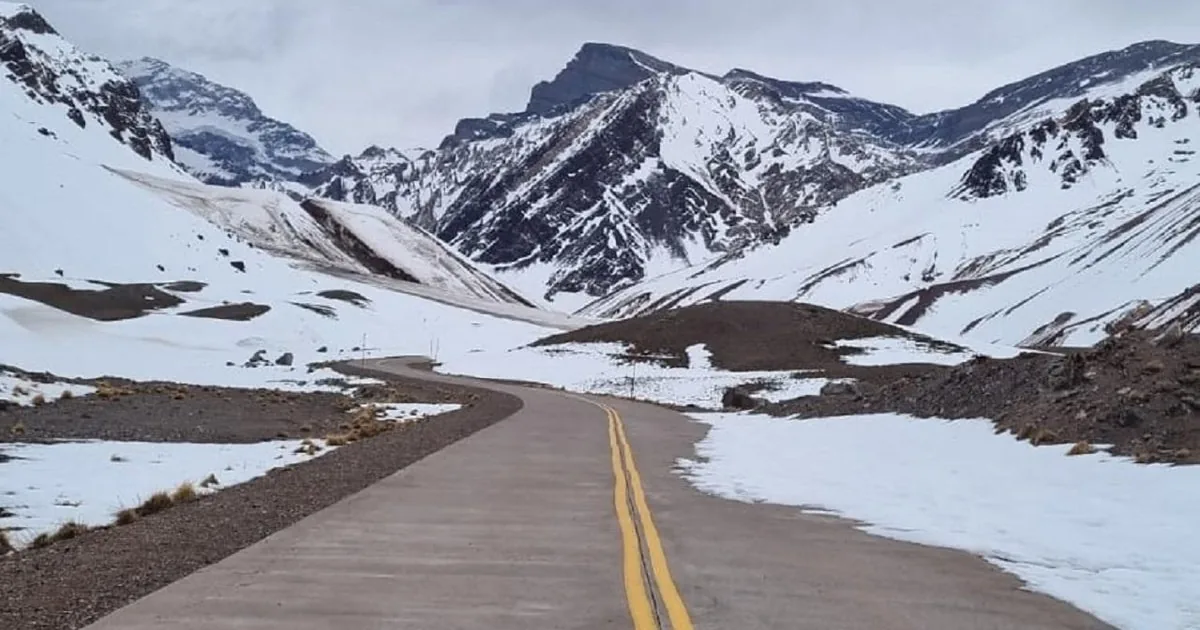
weather permitting, and in winter they drive through snow, although Route 7 can close in a storm.
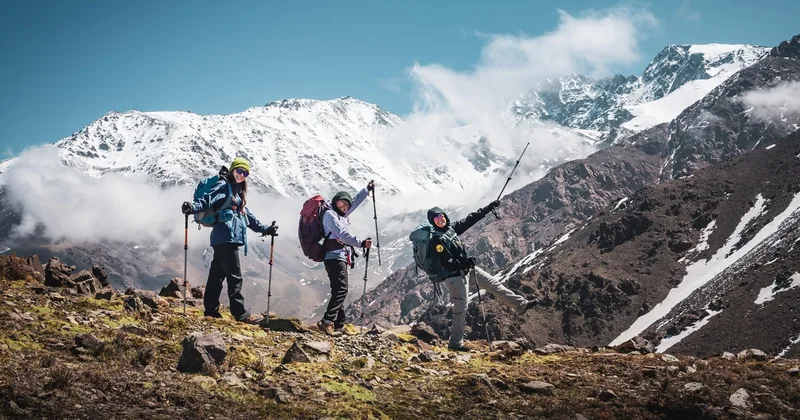
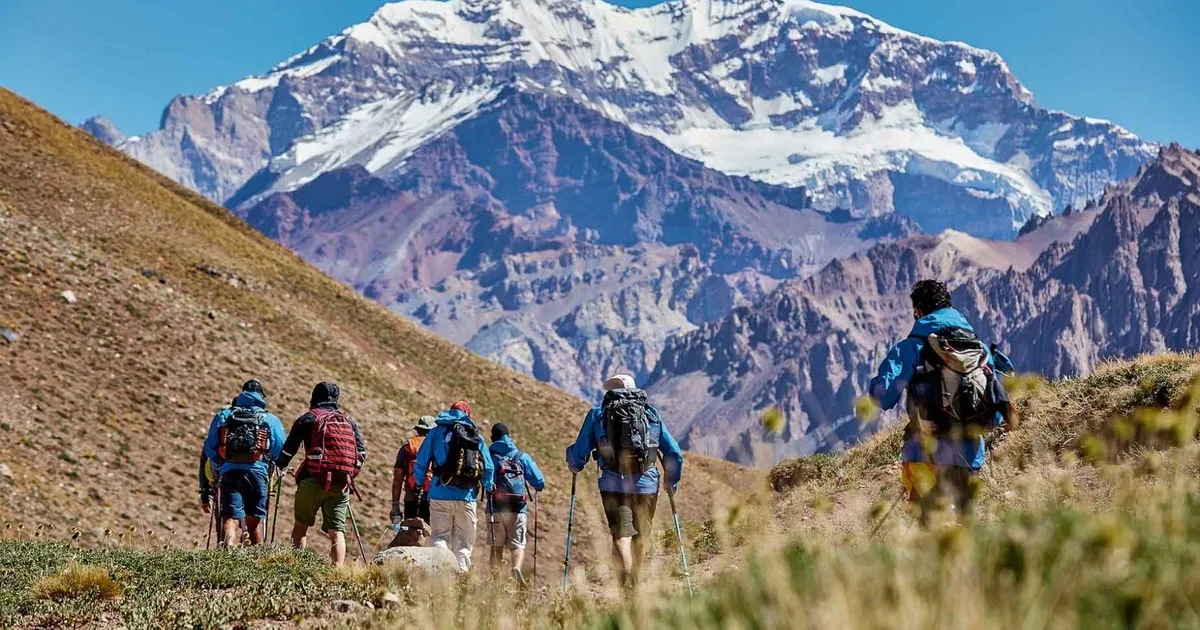
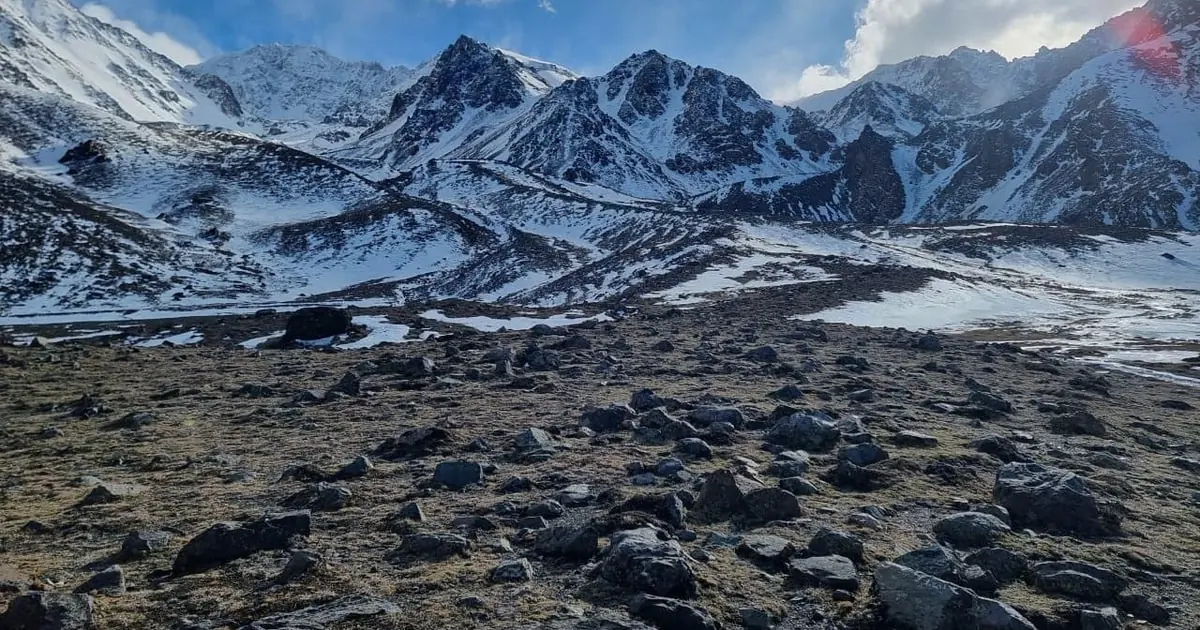
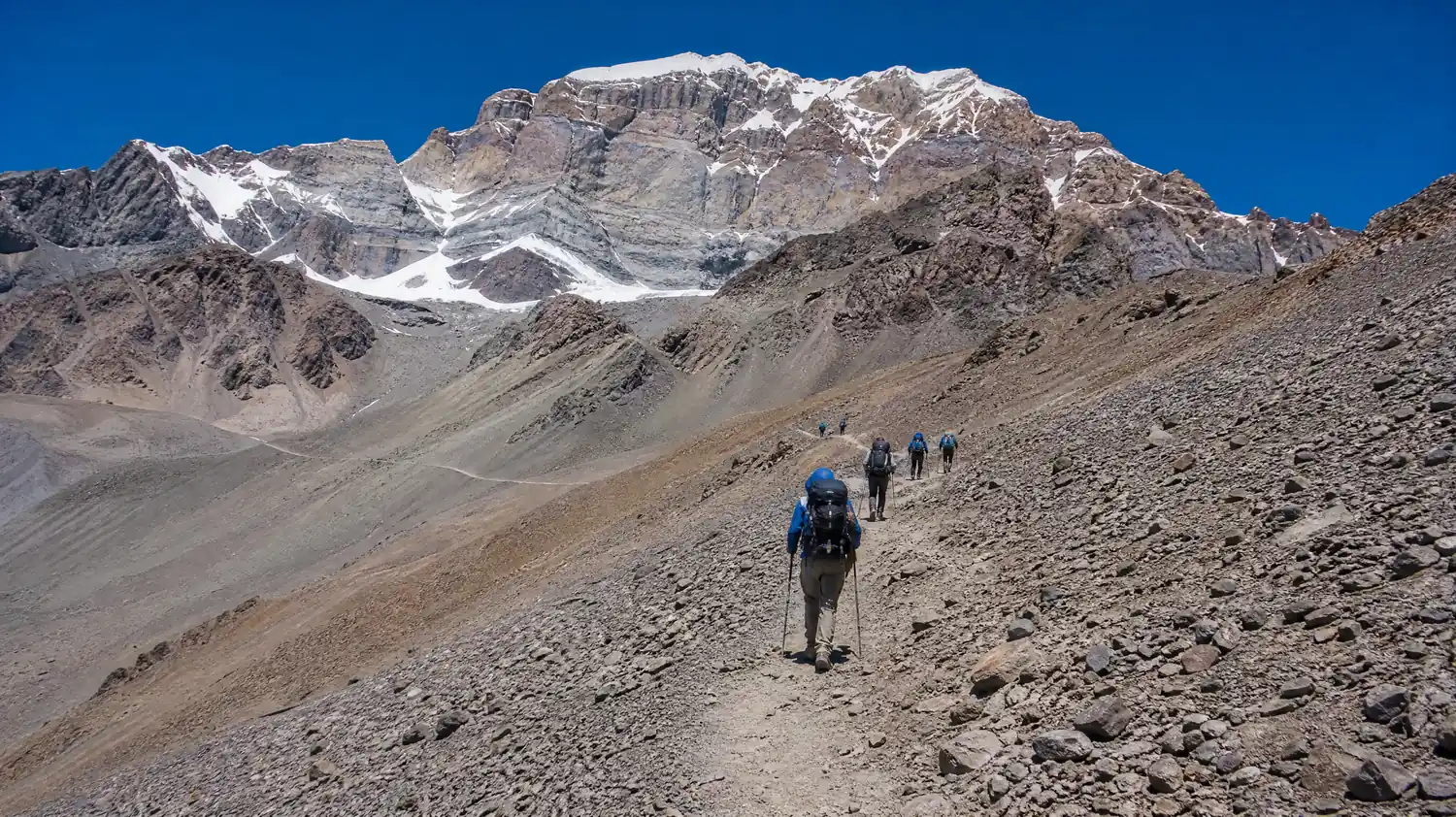
Slow and steady on loose scree: the pace that works at altitude.
Straight answers to what people ask most about hiking at Aconcagua.
How hard is it to hike Aconcagua?
It depends which Aconcagua you mean. The Laguna de Horcones loop is an easy 2 km walk at about 2,900 m, and the Confluencia day hike is a steady 6 to 8 hours return with about 500 m of climbing. The summit is different: a non-technical but serious high-altitude expedition of about three weeks, where cold, wind and thin air are the real test. More in how hard Aconcagua is.
Can you hike Aconcagua without climbing to the summit?
Yes, and most visitors do. The Laguna de Horcones loop looks straight at the South Face, the day hike follows the Horcones valley to Confluencia camp, and longer treks reach the Plaza Francia viewpoint or Plaza de Mulas base camp. Trekkers may not go above 4,300 m. The treks step by step in the Confluencia and Plaza Francia treks.
How long is the hike to Confluencia?
About 3 to 4 hours up the Horcones valley from the park entrance and a little less back down, so 6 to 8 hours return, with about 500 m of climbing to roughly 3,400 m. From Mendoza it is a 12-hour day, because the drive to the park takes about 3 hours each way.
Is a guide required for Aconcagua?
Not for the Laguna de Horcones loop, the Confluencia day hike or the 3-day trek. The 7-day trek to base camp must be done with a licensed outfitter. For the summit, a guide is not legally required on the Normal Route, but most climbers go with a licensed outfitter. The rules change by season: see permits and guides.
Do you need oxygen to climb Aconcagua?
No. Aconcagua is climbed without supplemental oxygen; outfitters and the park doctors keep bottled oxygen only for medical emergencies. What you need is slow acclimatisation: most expeditions spend two weeks or more getting used to the altitude before the summit day.
How many days does it take to climb Aconcagua?
Most outfitters plan 18 to 20 days from Mendoza and back on the Normal Route, including the walk in, rest days, carries between camps and spare days for bad weather. Shorter plans of 12 to 15 days exist for climbers who arrive already acclimatised. Day by day in how many days you need.
What time of year is best for Aconcagua?
The southern summer. Treks and climbs run roughly from November to March, with full park services (rangers, doctors, rescue) from about December to early March, and January is the warmest and busiest month. Day tours to the viewpoint run all year, weather permitting. Month by month in the best time to go.
Is Aconcagua harder than Kilimanjaro?
Yes, much harder. Kilimanjaro (5,895 m) is a walk-up of about a week with porters; Aconcagua is about 1,000 m higher, far colder and windier, and takes about three weeks, carrying your own loads above base camp. Many climbers do Kilimanjaro first. The big peaks side by side in Aconcagua compared.
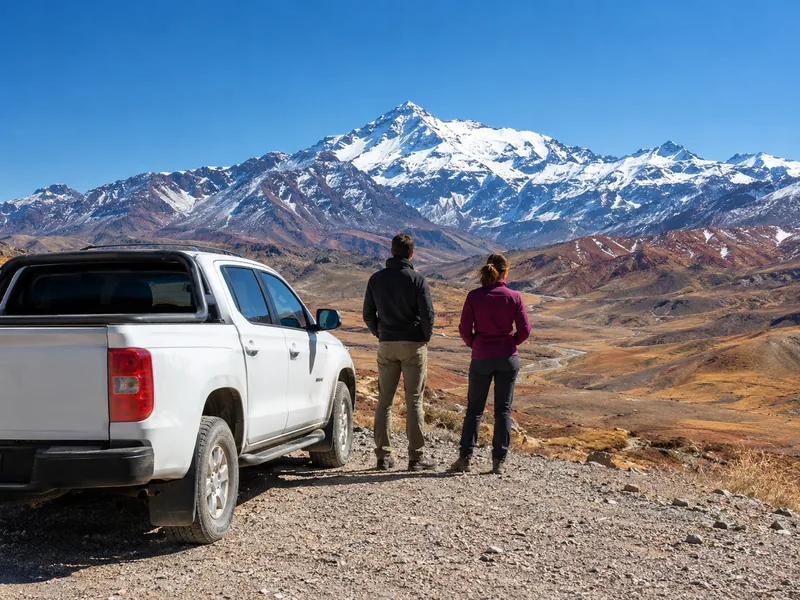
Can you see Aconcagua on a day trip from Mendoza?
Yes. The mountain is not visible from Mendoza city, but the high mountain day tours drive about 180 km up Route 7 to the viewpoint at Horcones, inside the park, where the South Face fills the view on a clear day. Expect a 10 to 12 hour day with stops at Potrerillos, Uspallata and Puente del Inca.
Do you need a permit to visit Aconcagua?
For the roadside viewpoints, no. The Laguna de Horcones loop needs a day ticket from the park, and anything further in needs a permit: a day-trek permit for Confluencia, trekking permits for 3 or 7 days, and a 20-day permit to climb. Permits are sold online by the park or through licensed outfitters.
What is the success rate on Aconcagua?
Only around a third of people who set out for the summit reach it, although figures vary by source and guided teams report higher rates. Weather, altitude illness and a tight schedule are the usual reasons people turn back, which is why spare weather days matter so much.
How expensive is it to climb Aconcagua?
The main costs are your flights, the park permit (foreigners and independent climbers pay the higher rates), an outfitter package with base camp services and guides, mules to carry your gear, rescue insurance, your equipment and hotels in Mendoza. A guided expedition costs far more than the day hike or a day tour; check each listing for the live price.
Ready to go
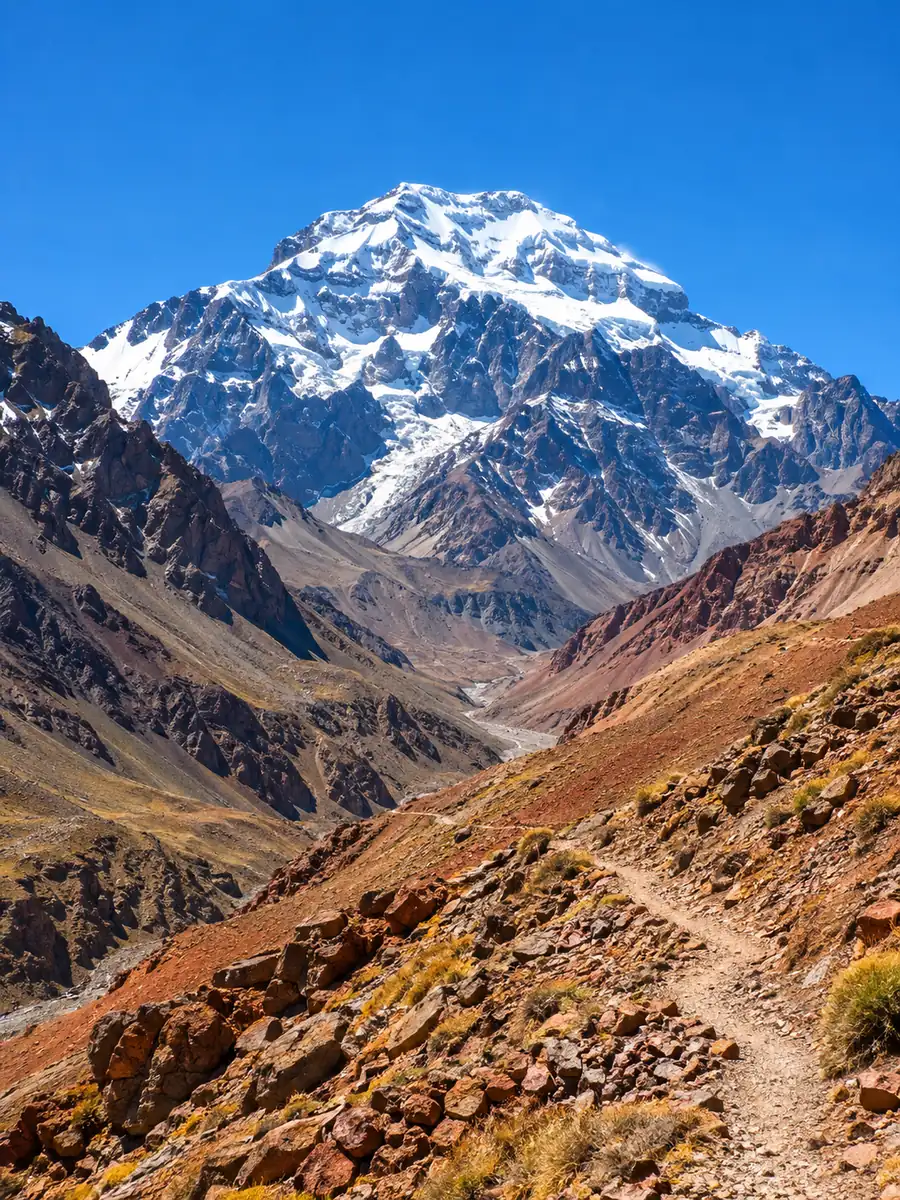
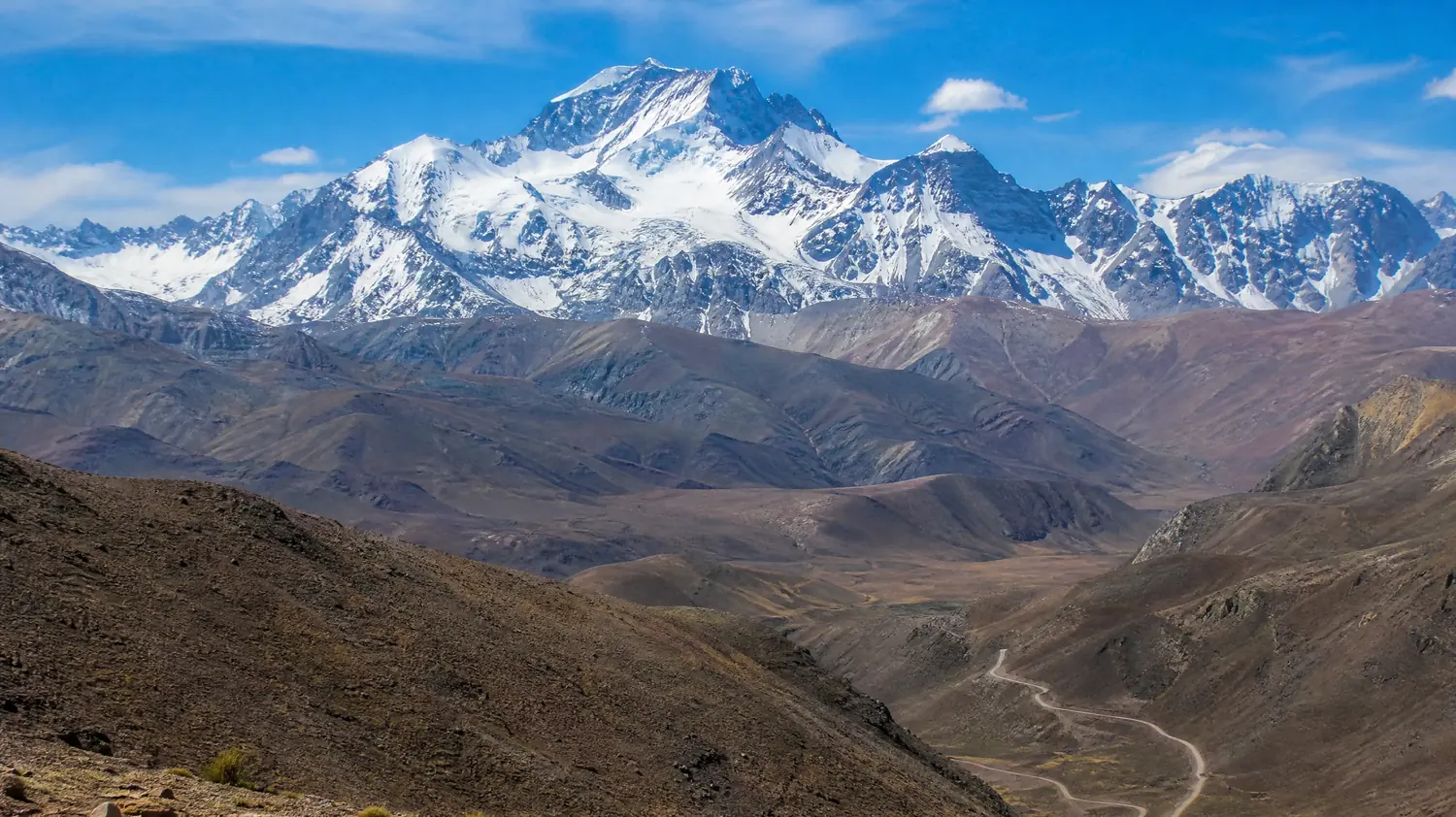
Early start, a long valley, the giant ahead.
Instant confirmation on GetYourGuide, with the refund terms shown on every option.
 Most booked
★ 4.812 hours473 reviews
Most booked
★ 4.812 hours473 reviews